Our goal for our home is to move completely off of gas and onto electricity and we need the solar system size to be adequate for the task . When we started, we were not heavy users of electricity, using 10-15 kWh per day, with our biggest uses coming from household appliances (washer, dryer, fridge, oven). We had gas for ducted heating, hot water, and stove top. Although the bills for gas were seasonal they were larger on an annual basis.
When considering how large a solar/battery system we wanted to install, we wanted to be able to avoid drawing from the grid as much as possible once we replaced our gas appliances, but were realistic about not sizing the system too large. We also want to be able to charge an EV in the future, so that motivated putting in a reasonably large number of panels to be able to power the house and also charge the car using solar as much as possible.
We asked the solar provide to help size a system for us and they provided the model shown below
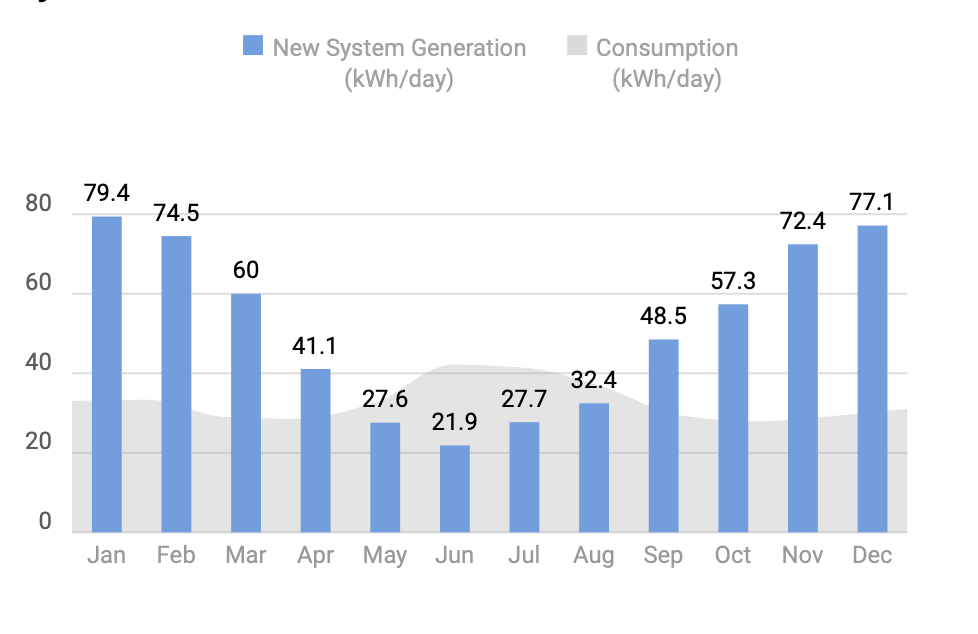
Proposed solar system size
The system they proposed had 30 PV panels (480 W each) placed on three of our home roof surfaces (E-8/W-13/N-9) and 27kWh of battery storage. The plot shows a model of our energy usage with heating and cooling and hot water moved to electricity in grey, and the average expected daily solar output in blue.
As feed-in tariffs are now essentially 0 in Victoria, there was no financial incentive to overproduce solar for feed-in, however this leaves a lot of potential to charge an EV for much of the year using only solar. This works for us as we often leave a car parked at home in the day and commute by bicycle. This size system also deals with the very large difference in solar production and energy usage in Melbourne throughout the year. Our largest electricity use for the home will be in winter (air conditioning is not really something we need very often) and that is when solar production is at a minimum.
The battery will allow us to time-shift electricity production from the day to the evening/morning when we need the heating, and also allow us to heat the house during the day which is something we have not really done with gas heating due to the expense.
Leave a Reply